Massage Guide
Foot Reflexology Chart

A foot reflexology chart is a map of the soles of the feet that links each area to another part of the body: the toes to the head, the ball of the foot to the chest, the arch to the stomach and intestines, and the heel to the lower back and pelvis. Reflexologists use it to decide where to press. This guide shows the chart, explains how to read it, and says what reflexology can and can't do.
The foot reflexology chart
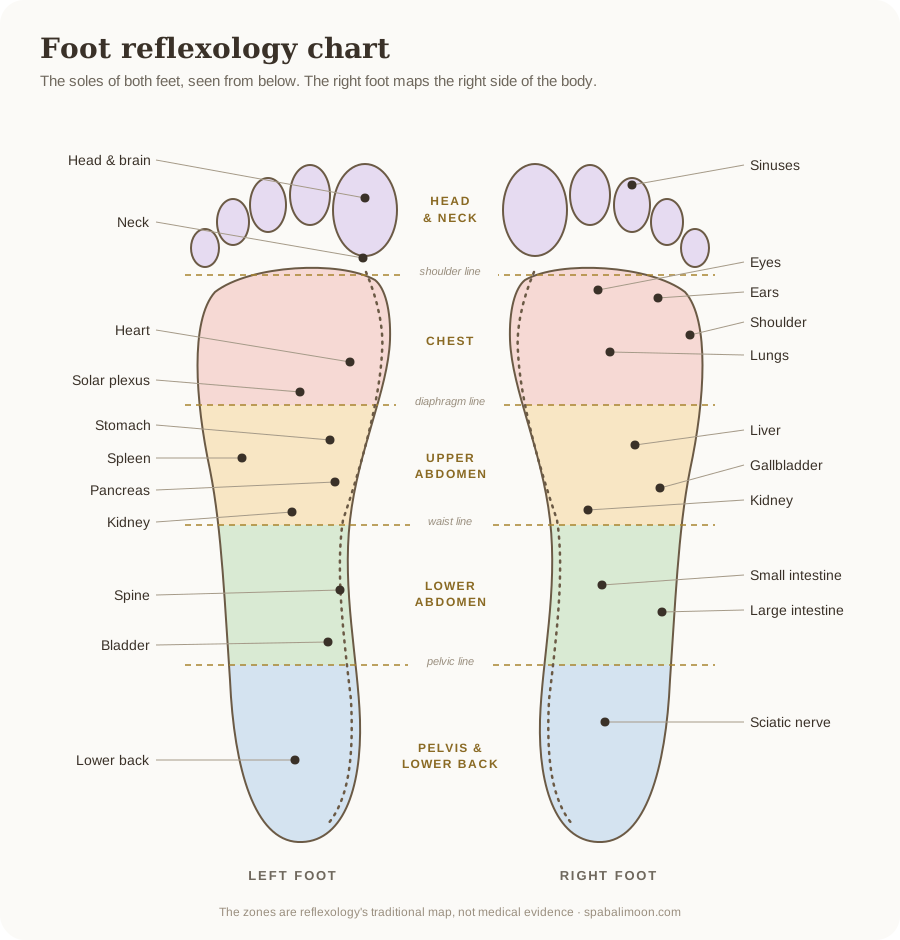
The chart shows the soles as if you were looking up at them through a glass floor: the left foot on the left, the right foot on the right, and the big toes on the inside. The body is laid over the feet with the head at the toes and the pelvis at the heels, and the right side of the body on the right foot. Most points appear on both feet; the chart labels each one once.
How to read a reflexology chart
Reflexology charts divide each foot with four lines across the sole, which split the body into five bands:
Part of the foot | Linked in reflexology to |
|---|---|
Toes | Head, brain and sinuses; the base of the big toe to the neck |
Base of the toes | Eyes (under the second and third toes) and ears (under the fourth and fifth) |
Ball of the foot | Chest and lungs, the heart (mainly the left foot) and the shoulders (outer edge) |
Upper arch | Liver and gallbladder (right foot), stomach, pancreas and spleen (mainly the left foot), and the kidneys |
Lower arch | Small intestine, large intestine (colon) and bladder |
Heel | Lower back, pelvis and the sciatic nerve |
Inner edge, from big toe to heel | The spine: neck at the top, lower back at the bottom |
The lines have names: the shoulder line at the base of the toes, the diaphragm line below the ball of the foot, the waist line across the middle of the arch, and the pelvic line where the heel begins. Charts differ in small details, but they all follow this layout.
Where foot reflexology comes from
Pressing and massaging the feet is an old practice in many cultures, including China and India. Modern reflexology started with "zone therapy", described by the American doctor William Fitzgerald in the 1910s, who divided the body into ten zones running from head to toe. In the 1930s the American physiotherapist Eunice Ingham turned his idea into the detailed foot maps used today.
What happens in a reflexology session
You sit back or lie down with your shoes and socks off, fully dressed. The therapist cleans and warms the feet, then works across each sole and along the sides with the thumbs and fingers, using small "thumb walking" movements and steady pressure on points from the chart. Most sessions last 30 to 60 minutes.
Some points feel tender, especially if you have been walking a lot. The pressure should feel firm but comfortable, so tell the therapist if it is too strong.
Does reflexology work?
There is no scientific evidence that pressing a point on the foot affects the organ the chart links it to, and reflexology can't diagnose or treat illness. If you have symptoms, see a doctor.
As a foot massage, though, it is pleasant and relaxing. Small studies have found that reflexology can ease anxiety and some kinds of pain for a while, much as other massage can. Most people simply find it soothing, especially after a long day on their feet.
How to try reflexology at home
Sit comfortably and rest one foot on the opposite knee.
Warm the foot by rubbing it between your hands for a minute.
"Thumb walk" across the sole: bend and straighten the top joint of your thumb so it creeps forward in tiny steps, from the heel to the toes.
Work along the inner edge of the foot, the spine line, from the heel up to the big toe.
Press and circle any tender spot for 10 to 20 seconds, then move on.
Squeeze and gently pull each toe, then repeat on the other foot.
Who should be careful
Reflexology is gentle and low risk. Skip it, or check with your doctor first, if you have a foot injury, an infection, broken skin, gout in the foot, a blood clot or poor circulation in the legs, or diabetes with numb feet. If you are pregnant, tell the therapist.
In short
A foot reflexology chart maps the body onto the soles: the head at the toes, the chest at the ball of the foot, the abdomen in the arch and the pelvis at the heel. Reflexology doesn't treat the organs on the chart, but it is a relaxing foot massage, especially after a day of walking. If you are in Bali, you can book foot reflexology in Seminyak at our spa or at your villa or hotel.
Frequently asked questions
What does the big toe relate to in reflexology?
The head and brain. The base of the big toe is linked to the neck, and its inner edge to the top of the spine.
Which part of the foot is linked to the kidneys?
The middle of the arch, on both feet, just above the waist line.
Which foot is the heart on in reflexology?
Mainly the left foot, on the ball of the foot towards the inner side.
What does it mean if a point on my foot hurts?
Usually that the area is tired or tight, often from walking or tight shoes. Reflexologists may read it as a sign about the linked organ, but there is no evidence for that.
Is reflexology the same as a foot massage?
Not quite. A foot massage relaxes the feet with general strokes and kneading. Reflexology follows the chart and uses thumb and finger pressure on specific points.
How often can you have reflexology?
As often as you like. It is gentle, so once or twice a week is fine.
Latest Posts

Keep reading
More Massage Guides
 Types of Massage: The Main Styles ExplainedThe main types of massage, what each feels like and who it suits, with a table to help you choose.Read the guide
 Swedish vs Deep Tissue MassageHow Swedish and deep tissue massage differ in pressure, pace and purpose, and which one suits you.Read the guide
 Hot Stone Massage: Benefits and What to ExpectHow a hot stone massage works, its benefits, what happens in a session and who should skip it.Read the guide